CouplingTerms
full name: tenpy.networks.terms.CouplingTerms
parent module:
tenpy.networks.termstype: class
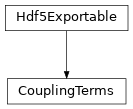
Inheritance Diagram
Methods
|
|
|
Add a two-site coupling term on given MPS sites. |
|
Add terms from |
|
Helping function to call before |
|
Load instance from a HDF5 file. |
Determine the maximal range in |
|
|
"Plot coupling terms into a given lattice. |
|
Remove entries close to 0 from |
|
Export self into a HDF5 file. |
Convert |
|
Convert the |
- class tenpy.networks.terms.CouplingTerms(L)[source]
Bases:
tenpy.tools.hdf5_io.Hdf5ExportableOperator names, site indices and strengths representing two-site coupling terms.
- Parameters
L (int) – Number of sites.
- coupling_terms
Filled by
add_coupling_term(). Nested dictionaries of the form{i: {('opname_i', 'opname_string'): {j: {'opname_j': strength}}}}. Note that alwaysi < j, but entries withj >= Lare allowed forbc_MPS == 'infinite', in which case they indicate couplings between different iMPS unit cells.- Type
dict of dict
- max_range()[source]
Determine the maximal range in
coupling_terms.- Returns
max_range – The maximum of
j - ifor the i, j occuring in a term ofcoupling_terms.- Return type
- add_coupling_term(strength, i, j, op_i, op_j, op_string='Id')[source]
Add a two-site coupling term on given MPS sites.
- Parameters
strength (float) – The strength of the coupling term.
i (int) – The MPS indices of the two sites on which the operator acts. We require
0 <= i < N_sitesandi < j, i.e., op_i acts “left” of op_j. If j >= N_sites, it indicates couplings between unit cells of an infinite MPS.j (int) – The MPS indices of the two sites on which the operator acts. We require
0 <= i < N_sitesandi < j, i.e., op_i acts “left” of op_j. If j >= N_sites, it indicates couplings between unit cells of an infinite MPS.op1 (str) – Names of the involved operators.
op2 (str) – Names of the involved operators.
op_string (str) – The operator to be inserted between i and j.
- coupling_term_handle_JW(strength, term, sites, op_string=None)[source]
Helping function to call before
add_coupling_term().- Parameters
strength (float) – The strength of the coupling term.
term ([(str, int), (str, int)]) – List of two tuples
[(op_i, i), (op_j, j)]where i is the MPS index of the site the operator named op_i acts on; we require i < j.sites (list of
Site) – Defines the local Hilbert space for each site. Used to check whether the operators need Jordan-Wigner strings.Operator name to be used as operator string between the operators, or
Noneif the Jordan Wigner string should be figured out.Warning
Nonefigures out for each segment between the operators, whether a Jordan-Wigner string is needed. This is different from a plain'JW', which just applies a string on each segment!
- Returns
Arguments for
MultiCouplingTerms.add_multi_coupling_term()such that the added term corresponds to the parameters of this function.- Return type
strength, i, j, op_i, op_j, op_string
- plot_coupling_terms(ax, lat, style_map='default', common_style={'linestyle': '--'}, text=None, text_pos=0.4)[source]
“Plot coupling terms into a given lattice.
This function plots the
coupling_terms- Parameters
ax (
matplotlib.axes.Axes) – The axes on which we should plot.lat (
Lattice) – The lattice for plotting the couplings, most probably theM.latof the corresponding modelM, seelat.style_map (function | None) – Function which get’s called with arguments
i, j, op_i, op_string, op_j, strengthfor each two-site coupling and should return a keyword-dictionary with the desired plot-style for this coupling. By default (None), the linewidth is given by the absolute value of strength, and the linecolor depends on the phase of strength (using the hsv colormap).common_style (dict) – Common style, which overwrites values of the dictionary returned by style_map. A
'label'is only used for the first plotted line.text (format_string | None) – If not
None, we add text labeling the couplings in the plot. Available keywords arei, j, op_i, op_string, op_j, strengthas well asstrength_abs, strength_angle, strength_real.text_pos (float) – Specify where to put the text on the line between i (0.0) and j (1.0), e.g. 0.5 is exactly in the middle between i and j.
See also
tenpy.models.lattice.Lattice.plot_sitesplot the sites of the lattice.
- add_to_graph(graph)[source]
Add terms from
coupling_termsto an MPOGraph.- Parameters
graph (
MPOGraph) – The graph into which the terms fromcoupling_termsshould be added.
- to_nn_bond_Arrays(sites)[source]
Convert the
coupling_termsinto Arrays on nearest neighbor bonds.- Parameters
sites (list of
Site) – Defines the local Hilbert space for each site. Used to translate the operator names intoArray.- Returns
H_bond – The
coupling_termsrewritten assum_i H_bond[i]for MPS indicesi.H_bond[i]acts on sites(i-1, i),Nonerepresents 0. Legs of eachH_bond[i]are['p0', 'p0*', 'p1', 'p1*'].- Return type
list of {
Array| None}
- remove_zeros(tol_zero=1e-15)[source]
Remove entries close to 0 from
coupling_terms.- Parameters
tol_zero (float) – Entries in
coupling_termswith strength < tol_zero are considered to be zero and removed.
- to_TermList()[source]
Convert
onsite_termsinto aTermList.- Returns
term_list – Representation of the terms as a list of terms.
- Return type
- classmethod from_hdf5(hdf5_loader, h5gr, subpath)[source]
Load instance from a HDF5 file.
This method reconstructs a class instance from the data saved with
save_hdf5().- Parameters
hdf5_loader (
Hdf5Loader) – Instance of the loading engine.h5gr (
Group) – HDF5 group which is represent the object to be constructed.subpath (str) – The name of h5gr with a
'/'in the end.
- Returns
obj – Newly generated class instance containing the required data.
- Return type
cls
- save_hdf5(hdf5_saver, h5gr, subpath)[source]
Export self into a HDF5 file.
This method saves all the data it needs to reconstruct self with
from_hdf5().This implementation saves the content of
__dict__withsave_dict_content(), storing the format under the attribute'format'.